Category: Fiction

  • I Won’t Look Back

    I Won’t Look Back

    It’s been seven days since I’ve seen my bed. 

    Seven long, tiring days, fraught with near misses and close calls, and every day, a doctor saying something about “touch and go.” 

    Touch and go: a phrase that feels more apt for a soccer game than a hospital room. Every time I heard it, I felt a new muscle in my body grow tense. Every time, I wanted to scream, “What is this? A field day or my husband’s deathbed?” 

    Instead, I’d simply nod, solemnly, with my arms crossed tight to my chest as my fingernails wore deep ridges into my biceps through each day, each code red, each slow beep of the machines tethered to my husband’s body. 

    But then the machines weren’t beeping. They just let out a long, sustained note, like the trumpets of hell calling out for the end times. 

    Is this the end times? I’ve asked myself this question at least a dozen times over the last seven days. Most days, it certainly felt like it. 

    If it’s not the end times, then how can you explain a man, the absolute picture of health, suddenly collapsing in his own driveway on a sunny Saturday afternoon? If this isn’t the end times, how does a 42-year-old man’s life blink out so quickly? How can any God get away with such a thing if it’s not the end of life for everyone, everywhere? 

    These past seven days in a small, cramped hospital room began to feel like I’d somehow found myself in hell – one minute, I was making dinner and the next I was sitting next to Hades, begging him to let my husband go. 

    But like the myth, he ate of Hades’ feast, a feeding tube snaking down to his stomach through his nose, the pomegranates of the underworld dripping into him through the I.V. in his arm. Though he did not eat willingly, he ate. 

    By day three, I knew he wouldn’t be leaving hell with me, but that didn’t mean I’d accepted it. Every day I woke with a start in the polyester-covered chair, expecting to see him awake, to see him smiling, making a stupid joke with one of the young nurses. 

    “My sweet, I am such an idiot,” he’d say. “I’ve made such a fuss, I’m sorry.” He’d reach his hand out toward me, I’d grab it, and he’d pull me onto the bed beside him, hugging me tightly as my body heaved with sobs. He’d shush me, tell me it’s alright, that he’ll never put me through this again, that this was all just a big misunderstanding. 

    Instead, it’s just six a.m., and the nurses are switching their shifts, and an orderly is changing the trash bins, and my husband is lying in a dimly lit hospital room with his chest barely moving, and the endless beeping of the machines goes steadily on. 

    On the first day in the hospital, I barely had time to think about the new reality we’d found ourselves in. He was rushed, on a gurney, from one side of the building to the next: EKGs and CT scans and MRIs and, in between, nurses and doctors floating in and out, drawing blood, poking at the machines, giving me sad smiles. 

    “Anything?” I croaked out, holding desperately on to hope with each heartbeat, each machine beep. 

    They all just shook their heads. 

    Day two, in the morning, as the sun opened a bright blue sky, and the birds were singing so loud that they almost drowned out the beeping, a doctor finally gave me something. 

    “Aneurysm,” he’d said, and I didn’t hear much beyond that. My eyes followed a bird out over the parking lot, tracing its flight through the sky as it flew in great sweeping arches, watching it weave between trees and cars and wheelchairs before it settled on the ground next to a small crowd of other birds in front of a bench where two old people tossed handfuls of breadcrumbs, showering them all with a dry, glutinous rain. The old couple laughed together, the old woman gently touching the man’s arm as she leaned back in laughter. 

    My face was hot with tears. 

    “I’ll give you some time,” the doctor walked out of the room. 

    Day five, I think, is when the walls closed in on me. By then, I’d stopped crying. I badgered everyone with questions. Every nurse, every doctor, every person bearing a hospital badge. I searched through every site I could find on experimental treatments, new medications, unusual options, western and eastern medicine alike. Spiritual healers, miracle workers, I called anyone who made a halfway decent claim that they could keep my husband from dying. 

    The bartering stage, I suppose. 

    I prayed to every god. I bit my tongue so hard it bled, and I wondered if the blood would be enough to appease some dark lord, if this could be a valid sacrifice, or if they’d want more. I wondered if I made my way into some supply closet or locked myself into the bathroom, and took something sharp to my wrists, how much blood would that dark lord need to heed my prayers? Half? All? I paced back and forth, questioning if all would be what I could give, and if I’d even have time to let it all out before some nurse or orderly found me and staunched the bleeding with a shirt or cloth or cotton rag. 

    For a full day, I thought nothing at all. I just stared – at my husband, at the near-stillness of his chest. It felt like I’d run out of thoughts to even think. I couldn’t move, didn’t eat. It felt like maybe I didn’t exist, or that I was there in the hospital bed, staring down death’s door instead. 

    The sun fell, and the hospital grew quiet. My eyes never left the place on his chest where, for the last 16 years, I’d laid my head every night to sleep. 

    With the sound of the sun rising, and the birds crying out the seventh day, I blinked, closed my eyes hard for a full minute, and decided it was time. 

    I moved to the edge of his bed and grasped his hand in mine, whispering that I was sorry. Though his hand was warm, there was an emptiness beneath his skin, as if he were already gone and I was just holding a broken, empty shell. 

    When the doctor came in for morning rounds, I told him I was ready, and a few moments later, the beeping slowed, then rang out the trumpets of hell again, then everything went silent. I felt his fingertips grow cold under my palm, watched the grey tone of death seep into the edges of his lips and the rim of his eyelid. 

    Closing my eyes, I whispered one phrase to the empty room: “I won’t look back.” 

    I walked out of the room, past the nurses giving me long, sad stares, down the four flights of stairs, and into the parking lot, wincing at the bright morning sun. Behind me, in the lobby, I heard a commotion, the sounds of a wheelchair rushing across the freshly waxed floors, but I pushed on. 

    Every step between me and the car felt heavier and heavier, like a tether was running from my back to his bed. It took all my strength to pull myself into the driver’s seat, the weight growing unbearable as I turned the key and pushed the rearview mirror away from me. 

    “Home,” I said, under my breath. 

    I would not make Orpheus’s mistake. I’d go the whole way, and once home, I’d sleep. In the morning, he’d be back. Hades would let him go; he had to. 

    So I drove, trying to let the soft summer air calm me. I began to grow accustomed to the weight, and as I pulled into the driveway, I avoided looking at the place where he fell, where a small pool of blood stained the concrete, like a dribble of wine from a delicately tipped glass. 

    I tore off shoes, jacket, pants, everything, with each step from the front door to the bed, and then I crawled in, closed my eyes, and slept. 

    I dreamt of him, both as he was and as he would be someday. I watched the long road of our marriage stretching out in both directions, saw our first kiss, our wedding, the day we fought so much that we didn’t talk for a week, the cause of the argument long forgiven and forgotten. I saw our future, too. Us both with grey hair, knee surgeries, and retirement parties. He flips through a catalog of boats at the kitchen table over coffee, and I shake my head, thinking of the financial strain on our fixed incomes. I see our gravestones, sitting neatly beside one another in a verdant field with bright pink and white flowers spilling from ornate pots. 

    I open my eyes, and it’s daylight, though I know not if it’s the same day or the next. 

    I call his name out quietly, moving my hand toward the empty pillow beside me, and I cry.
  • Shifting Time and Rings

    Shifting Time and Rings

    It was an average Tuesday night. Returning home from the grocery store after work, just past 6:30 pm, like always, Elizabeth tossed her keys in the dish on the small table in the entryway and placed her grocery bag on the floor beside it. She flipped the lights on, shrugged off her coat, and hung it on the hooks next to the front door. She muttered to herself, bits and pieces of thoughts, about hoping the chicken was defrosted or else she’d need to find something else to cook, and about how she’d really like to change the rug in the entryway hall, and about how she needs to remember to bring that notebook for Sheryl tomorrow. 

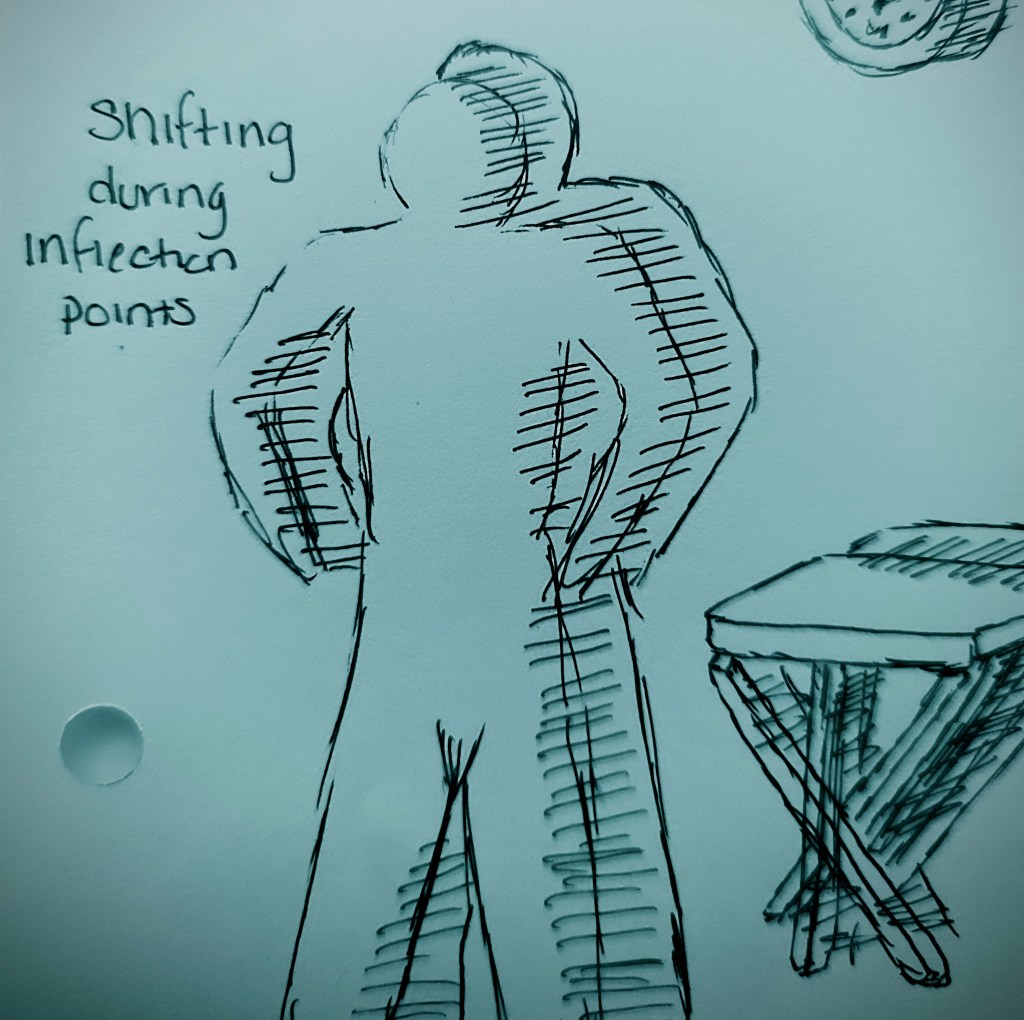
    As she walked down the hall toward her living room, the floor began to shake. Growing up in California, she knew what an earthquake felt like, and this was somehow different. It felt as if the floorboards themselves were shaking rather than the building or the earth. 

    She reached out to stabilize herself, knocking a photo of her father off the wall in the process. Rather than feeling the textured paint of the hallway wall under her palm, it was as if she felt it in points and spots around her hand, and a cold, dark nothing elsewhere. But there was more. She could feel the wood beam beneath the drywall, the metal nails, the rubber-coated wires. Her hand felt as if it were both on and in the wall simultaneously, while also being somewhere else entirely.  

    She looked down at her feet and could see her socks, her bare feet, the wood floors, the ground beneath her house, everything in fast moving bits and pieces, shifting back and forth, overlapping out of order and merging into nonsense patterns. She put her hand in front of her face and here and there on her palm, she could see all the way down the hall and out past her living room windows, down the street, and beyond. 

    It all became too much, and her head went cold as she passed out, not even feeling the floor come up to meet her. 

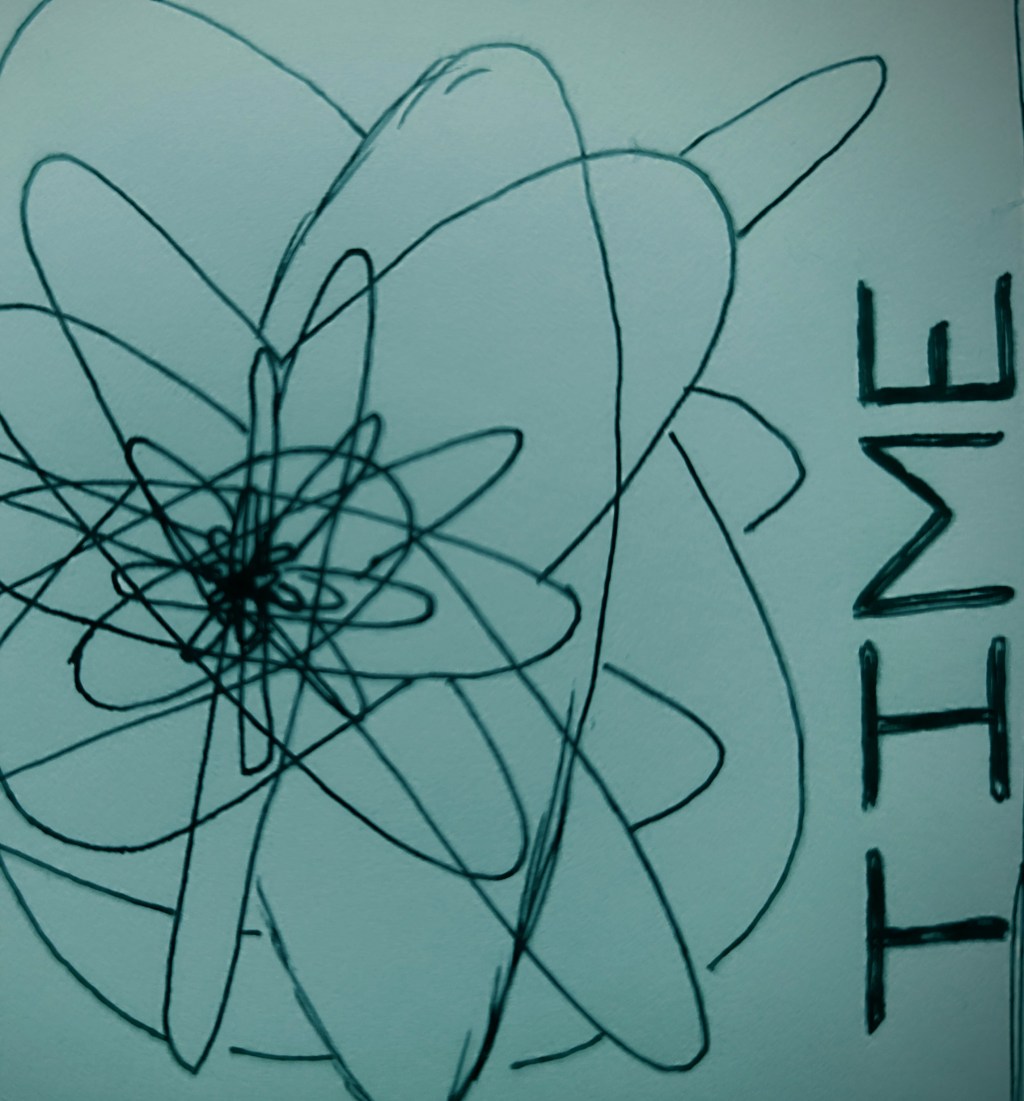
    Time is a series of rings circling a central point 

    that is the beginning and the end. 

    Some rings are long and thin, 

    while others are rough and wide. 

    The first shift is the hardest. 

    Elizabeth awoke in a small, dark room on a twin-sized bed. She checked the clock. An hour to go before work. She rolled over and pulled the covers up over her shoulder, stretching her legs out to the foot of her bed and letting out a soft yawn. 

    Another Thursday, she thought, sitting up and rubbing her eyes. 

    After showering and a quick breakfast of toast with honey and butter, she walked to catch the bus to work. It was a fall day in Dallas, but the sun still blazed on her arms through the bus window, making her sweat under her coat sleeves. 

    Her workday passed much as it always did, filing paperwork, answering phones, taking messages. Everyone in the office was buzzing about the big event the next morning, the other girls chattering about what dress they might wear, and what they thought others would be wearing, and who was taking whom to watch. Elizabeth, feeling her typical level of invisibility in the office, ate her lunch in the park outside, watching the cars rush up and down the street, seeing people milling in and out of the county court.

    Suddenly, it was growing dark outside. Elizabeth had been caught up in a particularly frustrating task of locating a specific box of books for a client on the sixth floor. Because of the renovations, everything was a mess, and while she could have sent one of the salesmen to locate it, she found she liked the quiet solitude of the upper floors, away from the chatting and laughs.

    Deciding she’d locate the box on Monday, Elizabeth headed downstairs to her desk, grabbed her things, and walked to the door. When she got outside, the chill of a crisp late November breeze reminded her of her coat. A janitor in the lobby walked her up to the sixth floor, unlocked the door, and turned the lights on so she could find it. He left, asking her to close up on her way out. She found her coat under a few boxes near the East wall, flipped off the lights, and headed home. 

    As she walked through her front door, she felt the floors shaking in a peculiar way. 

    I’ve felt this before, she thought, though she wasn’t sure where or how or when. She put her hand out to the wall to steady herself, and felt her hand go through the wall, as her feet felt the bare wood under the tiles of her entryway. She heard the faint click of her front door closing as the world went dark, and she hit the floor.   

    Some rings spin quickly 

    around the central point, 

    rocking and wobbling. 

    Others move 

    slowly 

    and 

    steadily. 

    You get used to the shift.

    Elizabeth found herself staring up at a rough wood ceiling, a cabin roof, lying on a mattress filled with straw. The rooster outside cawed and screeched, and the hens could be heard bobbling about the yard, pecking at the hay and seeds and pebbles.

    She hurriedly got up and began pulling on her stockings and apron. The cabin was cold, and the embers in the fireplace smoked lightly and lazily. Across the one-room house, her housemate slept soundly in her bed, snoring softly, her chest rising and falling with a steady rhythm. Elizabeth’s housemate worked in the tax office in town, helping the British soldiers record tax intakes and organize their correspondence. Being Saturday, she could sleep in and spend her day walking the square or watching the boats in the harbor, but Elizabeth wasn’t so lucky. The bakery could not afford to stop for a day. After all, everyone needs bread, regardless of what day of the week it is. 

    The streets of Boston felt tense, with British soldiers milling about every corner and potential rebels glaring at them across mugs of beer or the daily newspapers. Elizabeth had no time for politics between her daily work and nightly studies. She was learning to be a healer from an older woman in town who gave her books to read, covering everything from animal butchery to herbal medicine. 

    Her mind wandered as she rushed down the busy roads toward the bakery, trying to recall which plant was best for headaches and which for nausea. She turned a corner and accidentally bumped into a British soldier standing with a cup of coffee in one hand and a letter in the other. His coffee spilled across the page, sending the black ink spiraling across the page. Elizabeth hurried onward, not wanting to draw his ire, so when he turned to find the culprit, he found a decidedly drunk rebel leaning against a wall, talking in slurred words to a group of men. 

    Behind her, Elizabeth could hear the British soldier confronting the man, the man yelling back, and an altercation beginning, the noise drawing a crowd from every neighboring street. Elizabeth pushed on and opened the door to the bakery. As she walked through the entrance, her head began to spin. The floor felt uneven and shaky, and as she raised her hand to her head, she felt her vision blur, the bakery around her going dark. 

    Every so often, 

    rings collide: 

    an inflection point, 

    where their journey around the central point may restart.

     It’s at these points 

    where you shift 

    from one ring to another 

    to journey through 

    to the next inflection point,

    when you’ll shift again. 

    Elizabeth could feel the weightlessness and cold, empty dark before she opened her eyes. Even when she opened them, she found nothing, floating in a blank space. 

    She began to think to herself, “Where am I?” but before the thought finished forming, an echoing, soft voice replied. 

    This is the beginning

    And the end.

    The response made no sense to her, but she couldn’t finish forming full sentences before the voice began, sometimes so softly she could hardly hear, only catching a few words here and there, none of which made any sense to her. 

    Creating moments and cycles.

    Begin again. 

    The inflection points. 

    You shift.

    The word shift struck something in her, and she felt memories flooding over her mind. An apartment in the late afternoon. An office building with boxes of books. A hay-filled mattress and red-coated men. Something felt important about these memories, but she couldn’t place them. 

    She remembered going into the room with the boxes of books, finding her coat, and leaving. 

    But, you didn’t lock the door.

    The voice whispered, its tone somehow accusatory. Her conversation with the security guard slowly came into focus. He had asked her to lock it, and she couldn’t remember locking it on the way out. 

    The door was unlocked, 

    so he got in. 

    He had a view. 

    He aimed, 

    shot, and ran. 

    An image of the British soldier flashed before her, and the sounds of the fight she caused rang in her ears. 

    The drunken man died,

    and his death sparked a war,

    staining blue water brown

    and streets with red.

    Every so often, 

    rings collide: 

    an inflection point, 

    where their journey around the central point may restart.

    It’s at these points 

    where you shift 

    from one ring to another 

    to journey through 

    to the next inflection point,

    when you’ll shift again.

    The voice stopped, silence, and Elizabeth felt her skin tremble as her head went blank and consciousness slipped away.

  • The last dying glimmering shimmers of something magical occurring

    The last dying glimmering shimmers of something magical occurring

    It’s hard to find yourself on your own. Rarely is it the touchingly-melancholic coming-of-age journey that Hollywood portrays. Most often, it’s a violent and painful childbirth that lasts months or even years. At times, the labor may slow or stop, and you find yourself thinking Wow, it happened: Finally. I’m so excited to go enjoy my life as a fully formed and healed human. Then, nearly as soon as it stopped, as if to reassure you the universe is absolutely never on your side, the labor begins again, ten fold, and the cycle repeats.

    I guess what I’m trying to say is sometimes, you’ve got to look yourself in the mirror and congratulate yourself for not trying to commit suicide that day. Unfortunately for me, today is not one of those days. 

    I really thought dying would be easier. I guess I always believed humans are relatively fragile things. So, when I decided to try to end it all, I did it in a very typical-for-me dramatic fashion that I was certain would seal the deal: by taking a handful of hydrocodone and falling from the roof of a 5 floor walk up in Brooklyn.

    But I didn’t do it because some great tragedy occurred. I had no lost love I yearned to return to, nor some wrong my lack of existence would right. I did it because I stopped believing in magic. And yeah, I know how silly that sounds, but from the earliest age I can remember, I believed so fully that magic must exist. It became a religion to me of sorts, as if finding the proof would make the universe and existence make sense, give it purpose, provide real reason to it all. This search for proof quickly evolved into my only reason for getting out of bed each morning. I was convinced that one of these days, I’d turn a corner and see the last dying glimmering shimmers of something magical occurring, that I’d step on just the right spot on the sidewalk and feel the soft warm twinkle of electricity rise through my bones, that I’d wake up one morning to the sky being just the wrong shade of blue and catch a glimpse of someone repainting it from what they believed to be the privacy of an early morning rooftop. 

    But as I grew up, life methodically and systematically wretched every piece of hope in this belief from my bare hands. I was holding on to scraps of it, trying to push through each day, do my job, pay my bills, swipe on dating apps, have boring and normal conversations with my boring and normal friends. 

    The more hope that I lost, the more a deep and unsettling loneliness crept into me. It wasn’t something any human or animal could solve. It wasn’t something therapy would fix. It was just a hole where hope used to live — where magic used to live.  

    I tried so many things before coming to my ultimate and final conclusion: I tried drugs, drinking, sex, art, music, film. I tried exercise, meditation, medication, and distraction. I tried religions, plural, and books and self-help tapes and hair dye. Nothing worked. With each day, the emptiness grew. The feeling of being fully alone in a vast expanse of nothing grew so big that I couldn’t move. How can anyone move when it seems like a light-year separates you from the front door, like a hundred years of walking is keeping you from the outside world? 

    Admittedly, though, it wasn’t all on purpose.

    I remember it was raining. That’s the only reason I went up to the roof in the first place: I could hear the soft patter of spring rain on the fire escape growing into a deeper, darker, wilder thunderstorm and, having already taken the pills, the desire to see the magic of lightning dance across the New York City skyline one last time was gnawing at the base of my skull like a bad migraine. So, I grabbed my raincoat, tossed some cheap, $5 slides from Target on, and climbed out on the fire escape. 

    The wind was thrashing the side of the building, but, if anything, I think that was keeping me glued to the ladder more securely. It wasn’t until I got to the top rung and put my hand in a small pile of bird shit that things turned bad. I ripped my hand back, because who wouldn’t? This was supposed to be a magical moment: slowly fading into the void with the backdrop of lightning, skyscrapers, and wild wind. But now, my hand was covered in a smelly, wet, white goo. Unfortunately, in my state, I may have ripped my hand away a little more aggressively than I intended. I did say I could be dramatic at times. What did you expect, the pills lessened that?

    Well, then I was falling, and I hate the feeling of falling. So, in the moment, there were some regrets about this whole decision, sure, but only in the sense that my original plan was perfect and this, well…it just wasn’t. I swear I ran through every stage of grief in that fall, cursing the bird that had the audacity to shit on the ladder, cursing myself for changing the plan. I thought maybe I had already died and this was my eternal hell. I started spiraling through how ridiculous everyone would find this, how my whole big dramatic end would become a sad and silly story instead of the beautiful climactic tragedy I hoped for. But, finally, as the ground came up below me, I figured this gave me the final result I wanted anyways and accepted my fate.

    However, waking up a few hours later in a hospital was an entirely unexpected result. I blinked hard against the harsh fluorescents trying to bring the off-white drop-tile ceiling into focus. As my eyes adjusted, I saw something even less expected than waking up in general: in the corner of the tile directly above me, the top right corner, I bore witness to a faint shimmering glitter, as if something magical had just occurred, as if I’d just missed it.

    I went to rub my eyes, but when I reopened them, the faint shimmer on the ceiling tile was gone, and I was torn between belief and denial. I sighed heavily and let my head fall back into the pillow. Neither choice seemed ideal at the moment. I kept staring at the spot, willing it to return, to tell me if I was going insane or not.

    A rough knock at the door startled me from my staring contest with the ceiling.

    “Lavinia Moscatelli?”

    I coughed out a weak yes, suddenly realizing how dry my throat and mouth were.

    “Had quite a fall, huh?” said the doctor, staring intently at a computer screen on a rolling-standing desk while walking into the room. He didn’t wait for me to respond. “Well, you got immeasurably lucky,” he said, looking up from the screen. “Nothing is seriously broken. You’ve definitely got a fractured rib, and some pretty serious bruising, a mild concussion, but, somehow, despite all odds, you could quite literally walk away from this accident without any real issues.”

    I glanced down at the IV in my arm, unsure how to respond.

    “My best guess would be that something happened similar to the way drunk drivers often survive when they crash into another car, but the other driver typically suffers serious injury or death.”

    “Uh…” I was confused by this sudden change in topic. 

    “Well, drunk drivers don’t brace themselves against the crash. They don’t tense up. Sometimes, they may not even know the impact is coming. The alcohol acts as a muscle relaxer, subdues their anxiety, and slows their reaction times, so their body responds to the crash more fluidly, sometimes preventing certain types of injuries.”

    “…Okay,” I said, as he paused, looking at me expectantly.

    “It’s a similar theory here. You took enough drugs that your body just responded more fluidly to the fall, I guess. You didn’t tense up or really react to the impact at all,” he clasped his hands together. “So, it likely prevented some of the injuries.” 

    “Oh,” I replied, looking first at him, then at the blanket over my legs. “I see, I guess.”  

    “Look, I’ll level with you,” he sighed, pushing the rolling computer to the side and sitting down on a rolling stool near the bed. “I think it’s pretty obvious that this was a suicide attempt… People don’t accidentally eat a bottle of pain meds and fall off roofs.” He looked into my eyes like he was searching for something, so I turned my eyes down. “Most people who die for seven minutes come out of it regretting making an attempt. They say they never intended to kill themselves, that it was all a misunderstanding, they didn’t mean it, whatever.”

    “…seven minutes?” I asked, briefly making eye contact with him before looking away, trying to avoid the doctor’s uncomfortably earnest stare.

    If the sincerity wafting off this doctor like a bad cologne wasn’t bad enough, I suddenly heard a sound from down the hall, the last sound I wanted to hear right now: my mother’s voice.

    My 65-year-old born-and-raised-in-Queens mother, who’d barely left the borough a dozen times in her life – I’m sure you can imagine the type – was clicking her way down the hall in Canal Street-bought Jimmy Choo heels, aggressively asking every orderly and nurses aid where her “little stellina” is being held.  

    My mother’s the type where she sees her life as a never ending string of personally offensive tragedies. So, I could be certain my “accident” would inevitably be turned into something I did on purpose to try and ruin her life.

    She pushed her way into the room, past the doctor, and began babbling a string of Italian-American terms of endearment and concern between pointed questions at the doctor about whether I’d be okay, how badly I had been hurt, who did this to me, and when I’d be able to go home, never giving the doctor a moment to respond. 

    “I’m fine, ma, really,” I said, holding my hand up to keep her from getting too close. I could feel my head beginning to spin with the overwhelming nature of her arrival. “He said it’s just a broken rib and a light concussion. I’m going to be okay.” 

    “Oh stellina, how did this happen? Why? Did someone do this to you?” Please don’t be fooled by her performance, she is more concerned about what the neighbors will say about this than my actual injuries. 

    “I’ll give you guys some space. We’ll probably be able to discharge you within a few hours. I’ll be around later to check-in before you leave, though,” the doctor said quickly, backing out of the room with his rolling computer-desk. 

    And then the real worries of my mother came spilling out. She cried, pulling tissue after tissue out of her knock-off Coach purse, about how she must have been the most terrible mother for me to have decided to do something like this. She ranted about how she always tried her best but it was clearly not enough. She called upon God, Jesus, the Holy Father, and the Pope to explain to her what she did so wrong in her life to deserve a trial like this. I’ll spare you the details, mostly because I’d learned long ago to stop listening when she gets like this and wait out the storm. 

    I can’t say for certain how long she went on, but my relief when a nurse finally walked in was immeasurable. After a series of vitals tests, bland hospital food, and several medications for my broken rib and (not-accident-related) headache, the doctor returned and I was discharged. I fought in the parking lot with my mother for a solid twenty minutes — she insisted I go to her apartment, I refused. Finally, she caved when I promised to call her in the morning. She drove me home and I stood in the entryway of my apartment trying to process everything. 

    The pill bottle was still on my coffee table besides a bottle of Four Roses Bourbon and a few empty cans of Goslings Ginger Beer. The lights were left on, plates from the dinner last night sat on the counter in a haphazard pile. I put the bag of random belongings from the hospital down on the table and collapsed on the couch, the stress from all the things I’d need to do and clean before returning to work tomorrow beginning to ball into a heavy weight on my chest and the reasons for my “accident” reforming in my head. I closed my eyes against the lights of my living room and suddenly remembered what I saw on the ceiling at the hospital. 

    I shot up, likely too fast for my condition as the sharp pain on the side of my torso reminded me, and began to tear apart my house looking for any signs, any shimmers, any faint-glimmers or hints, anything that would validate what I believed I saw. I ripped everything from the closets, scanning the corners. I opened every cabinet, upturned every drawer, moved every piece of furniture. I was certain I would find something, anything, that would give me a sign I wasn’t imagining things. 

    There was nothing.    

     Sitting on the floor, you’d think I’d realize I must have just imagined it, that it must have been something in my eye or a trick of light or even a weird manifestation from falling five stories. I didn’t. As I slowly began to put everything back to normal in my apartment, I decided that I must have simply missed it or looked in the wrong place at the wrong time. The belief inside me that I’d see it again was so resolute, filling that hole where hope used to live. 

    And for weeks, I felt alive again. I woke up early, I took long and wandering routes to work every day, scanning every window, doorway, rooftop, and gutter with my eyes. I went out, I met up with friends, I spent weekends going to random subway stops and walking for hours, knowing that any moment I’d see something — I’d see some last dying glittering shimmers of something magical occurring. 

    But there was nothing. 

    Six months after my accident, I’d started therapy and was trying to move on. Since the first attempt to remove myself from society didn’t work, I stopped seeing a real need to try again. Instead, I resigned myself to the fact that life is a disappointment and the only thing to do is search for small moments of joy when they come. I let the hole where hope used to live reopen and lived inside it, distracting myself with work and friends and social media, trying to find a way to feel okay with being a shell. 

    For the most part, it worked. 

    One fall Sunday, seven months to the day after I unceremoniously fell out of the sky, I was having a normal day, walking back home from a coffee shop with a bagel and coffee, sidestepping puddles on the cold November sidewalks. Although I had stopped the meandering walks a few months back, something about the mild air and open schedule of the day inspired me. Instead of turning right on Myrtle Ave, I turned left and began to wander down random blocks. I wasn’t searching for anything anymore, though. This time, I was simply walking, forcing myself to find enjoyment in the exercise and sights, the couples with strollers, the dog-walkers, the fire-escape gardens Brooklynites built to stave off the terror of concrete and steel. As I slowly made my way back home, I felt for the first time like things might actually be okay, that this hole where hope used to live was manageable, and that perhaps the magic in the world was something more banal, like having a free Sunday afternoon in November to stroll through the streets of Brooklyn. 

    As I rounded the corner to my apartment, all my thinking collapsed, I dropped my coffee to the ground, spilling hot liquid on my shoes and pants, and I stopped breathing entirely. There, in front of the door to my apartment building, on the grimy city sidewalk, next to a puddle of old rain, and dirt, and spit, and cigarette butts, I saw it: the last dying glimmering shimmers of something magical having just occurred, but me too late to witness it. 

  • Dead Man’s Hat

    Dead Man’s Hat

    Peter sat on his bed, fingering the brim of the hat, feeling the soft wool, the smooth silk of the ribbon. He turned it over in his hands, holding it gingerly in his palms. Standing before the mirror, he placed it on his head, tilting his chin back and forth. Glancing upward, tiny specs of blood could be seen on the edge of the brim.

    “Peter, come on down here now boy, it’s time for dinner” his mother cheerfully called from the kitchen. Placing the hat down at the foot of his bed, he walked to the door. He took one last, longing look before closing the door behind him.

    In the kitchen, his father sat, newspaper in one hand, cigarette in the other. His mother placed his plate before him, smiling warmly down at him before seating herself. For Peter, the meal passed in a haze. He heard bits and pieces of conversation: next weekend’s chores, the weather, plans for Halloween and the holidays. His parents chatted happily as if nothing had happened the night before, as if everything were fine. Peter began to think he had dreamt it.

    “Peter, would you be a dear and take the trash out?” Peter snapped back to the present as his father flipped the page of the newspaper and his mother hummed softly drying forks and knives. Wordlessly, he got up and grabbed the bag of trash.

    The garage was cold, even for an early October night. As Peter lifted the lid to the garbage bin, he stopped short, noticing his baseball and glove sitting on the workbench a few feet away. Memories of the day prior came in waves:

    The last of summer sun struggling through the afternoon. His fathers wide smile with every toss and catch. Cool grass on his bare feet as he ran, backwards, to catch a long throw.

    He stopped himself before he thought too far but in the garbage can, he saw the rags his mother had used, blood stains and dirt. He shivered and stepped back, trash bag shaking in his hands.

    Sitting in the car just after dusk. His father’s words slightly slurred. A sharp turn and loud bang and screeching stop. Stepping out of the car, seeing the man’s body lying lifeless in the glow of the headlights, his hat at Peter’s feet. Peter grabbing the hat and running. Running through the woods, running towards home, the dirt hitting his calves and his breath ragged, but when he got there, the car was in the driveway. His mother filling a bucket of water and soap, father pulling rags from a shelf in the garage. Running to his room, and watching his mother clean the hood of the car with careful, gentle strokes while his father smoked silently to the side. Placing the hat down under his bed, turning the lights off, and trying to forget.